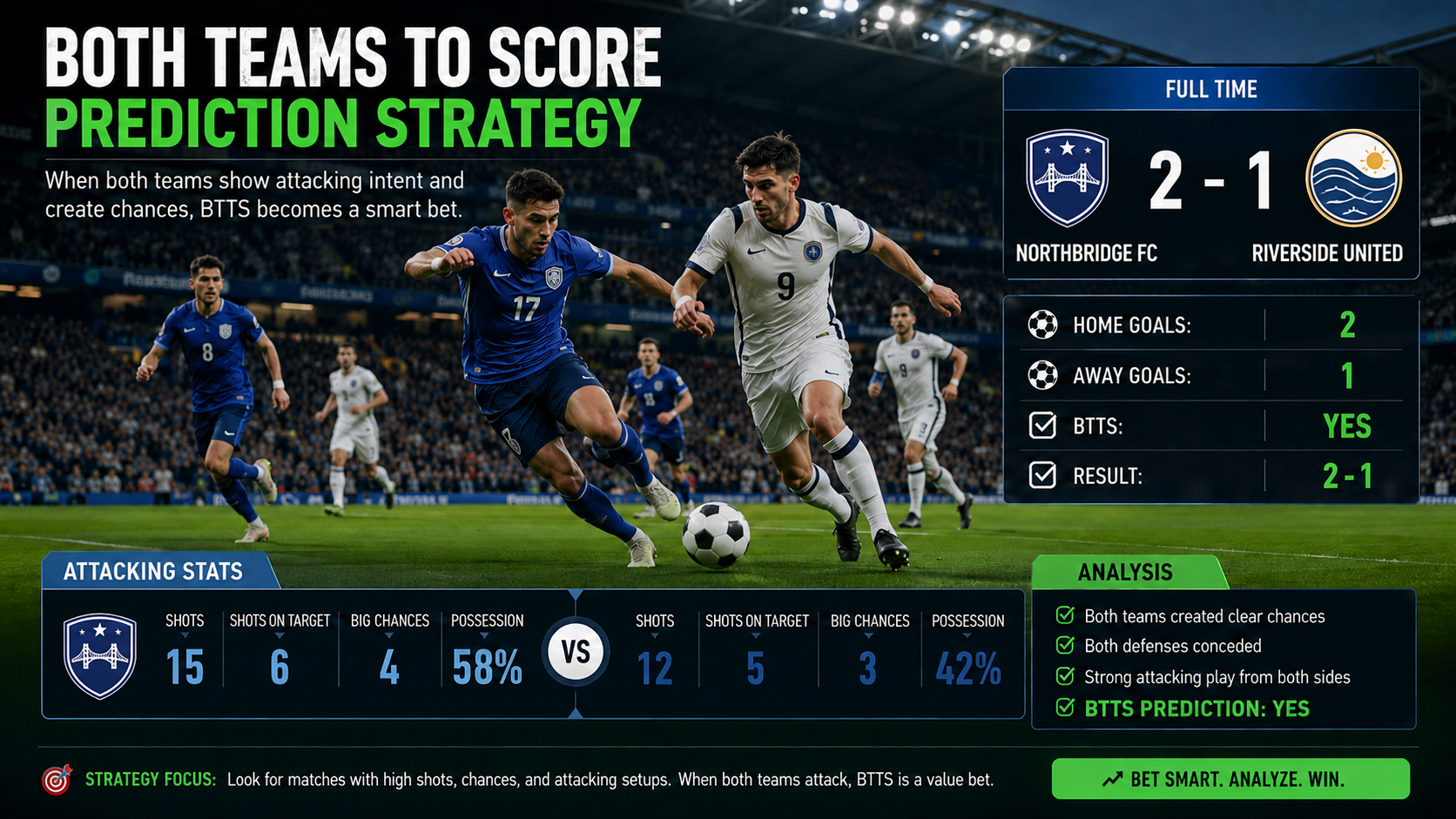
You fancy goals in a match but cannot settle on the winner. Rather than forcing a result pick, you start looking at whether each side can score.
That is what BTTS means: both teams to score. The market asks whether each team will score at least once. This guide explains settlement, the evidence worth checking and how to judge the price.
Key takeaways
- Check whether your selection is BTTS Yes, BTTS No or a combined market.
- Assess each team's scoring prospects separately rather than relying on a match's attacking reputation.
- Compare your estimated chance with the available odds before calling anything value.
- Be willing to pass when the price or team news leaves too much doubt.
- Set your stake within your bankroll plan, not around how exciting the fixture looks.
What BTTS means: Yes, No and settlement
BTTS Yes wins when both teams score. BTTS No wins when at least one team fails to score, including a goalless draw. The match winner does not matter for a standalone BTTS selection.
Standard football markets normally cover regulation time plus stoppage time. Extra time and penalty shootouts are excluded unless the market expressly says otherwise. Check the wording, especially when betting on knockout fixtures.
Half-specific markets are different. First-half BTTS concerns only the opening half; second-half BTTS concerns only the second. BTTS in both halves requires each team to score in each half.
Own goals count for the team credited with the goal on the scoreboard under bet365's published rules. Its abandonment rules also distinguish between an already-successful Yes selection and an unresolved market. Check your bookmaker's rules rather than assuming every interruption receives the same treatment.
BTTS versus over 2.5 goals and combined bets

BTTS and over 2.5 goals answer different questions. BTTS needs a goal from each team. Over 2.5 goals needs at least three goals overall, regardless of which side scores them.
Example: Team A draws 1–1 with Team B. BTTS Yes wins, but over 2.5 goals loses. If Team A wins 3–0 instead, over 2.5 goals wins while BTTS Yes loses.
Use our over 2.5 goals explainer when deciding which market best expresses your view. Ask whether you expect contributions from both attacks or simply plenty of goals overall.
Combined markets add conditions. A selection pairing BTTS with a match winner or goal total needs both parts to land. Both teams scoring alone is not enough.
Example: You back Team A to win and BTTS Yes. A 1–1 draw loses because Team A did not win. A 2–0 home win also loses because Team B did not score.
When BTTS deserves a closer look
Yahoo Sports' BTTS explainer identifies goals scored and conceded, clean sheets, home/away performance, likely line-ups, absences, playing styles and fatigue as relevant factors. These give you a better starting point than a fixture's reputation.
Assess attacking and defensive strength separately for home and away matches. Do not treat a team's overall record as a complete description of the particular fixture.
Build a case for each team scoring
For BTTS Yes, write a short case for the home side scoring and another for the visitors. Consider form, likely personnel and the opposing defence. If one case depends mostly on hope, leave the bet alone.
Two productive attacks facing weak defences may attract shorter Yes odds. A strong defence against a side that rarely scores away may attract shorter No odds. Neither pattern establishes value by itself.
Question the easy narrative
Do not let phrases such as home advantage or excellent form replace an actual argument. Ask what they mean for this opponent, this venue and the likely starting line-ups.
Use our both teams to score selections as a starting point for your own assessment. Before backing anything, write down why the less convincing attack should find a goal.
When the odds make BTTS worth backing
A potential value bet exists when your estimated probability exceeds the probability implied by the available odds. A likely outcome can still be poor value if its price is too short.
Implied probability expresses the chance represented by the odds. Bookmaker margins mean the implied probabilities of all outcomes can add up to more than the full probability total. Quoted prices are not margin-free assessments.
Comparing bookmakers can help you find a better available price. That is separate from establishing value: the best price on offer may still be too short for your assessment.
Treat your probability estimate as a judgement, not a measurement. If a small change in your view removes the apparent edge, consider passing rather than forcing a selection.
Worked examples: a good angle and a poor price
Example: Team A hosts Team B. You estimate BTTS Yes at 60%, based on your assessment of both attacks and defences. Odds of 1.80 imply about 55.6%, calculated as 1 ÷ 1.80. Your estimate suggests possible value. At 1.55, the implied chance rises to about 64.5%, so the same assessment no longer supports the bet.
The important distinction is between liking the outcome and liking the price. Keep those judgements separate when reviewing a selection.
Example: Team A has a strong attack, but you doubt Team B will score. You estimate BTTS No at 58%. At odds of 1.60, the implied probability is 62.5%. No may be your likelier outcome, but that price does not meet your own valuation.
Avoid changing your estimate simply to justify the available odds. If the evidence feels too thin to support a view, skipping the market is a reasonable decision.
Common BTTS mistakes to avoid
- Studying only the stronger attack. Give the less convincing team's scoring prospects equal attention.
- Calling a selection a banker. Keep confidence separate from price and uncertainty.
- Adding BTTS to an accumulator just to lift the payout. Judge every acca leg on its own merits.
- Ignoring the selection wording. Check whether you chose a standalone bet, a half market or a combination.
- Raising your stake to recover a loss. Keep your staking decision separate from frustration over previous results.
Choose a stake within your existing bankroll plan before placing the bet. If you need a framework, read our bankroll management guide. Keep betting money separate from essential spending.
BTTS questions answered
Does BTTS No win if neither team scores?
Yes. BTTS No wins when at least one team fails to score, so a goalless draw qualifies.
Does BTTS include extra time?
Standard football markets normally cover regulation time plus stoppage time, excluding extra time and shootouts. Check the specific market wording for exceptions.
Does an own goal count towards BTTS?
Under bet365's published rules, an own goal counts for the team credited with it on the scoreboard. Check your bookmaker's settlement rules.
Is BTTS Yes better than BTTS No?
Neither is inherently better value. The relevant question is whether your estimated probability exceeds the probability implied by the available price.
Back the assessment, not the excitement
Treat BTTS as a specific judgement about two scoring prospects, not a shortcut for backing an entertaining match. Be selective, question your assumptions and leave room to pass. First, check the market rules, assess both attacks, compare the odds and set your stake.